Our Story
Sprout City Farms is an urban agriculture nonprofit organization based in Denver, CO, started by a group of farmers, researchers, teachers, business leaders, and community members that came together in 2010 with a vision for increasing food access and community resiliency through farming underutilized urban land.
Our farms serve as a platform for education, health, food justice advocacy, ecological stewardship, community wealth building, and neighborhood resiliency.
We recognize that Núu-agha-tʉvʉ-pʉ̱ (Ute), Tséstho’e (Cheyenne), hinono’eino’ biito’owu’ (Arapaho), and Očhéthi Šakówiŋ peoples are the traditional stewards of the unceded lands we are farming.
Since 2010, SCF has built:
Denver Green School Community Farm (DGS), a one-acre organic vegetable farm established in 2011 in partnership with Denver Public Schools;
Mountair Park Community Farm (MAP), a 1.5-acre organic vegetable farm established in 2014 in partnership with the City of Lakewood;
Dahlia Campus Farm, a one-acre organic vegetable farm established in 2016 (and managed for 3 years) in partnership with Mental Health Center of Denver/WellPower (now managed by WellPower);
The Farm at Jack's Solar Garden, a three-acre vegetable farm under 5 acres of solar panels in Longmont, established in 2021 (and managed for 5 years) in partnership with Jack’s Solar Garden (no longer in vegetable production).
We continue to manage the DGS and MAP sites, and we also partner with organizations to build farms that serve their mission and programming. We worked with Mental Health Center of Denver (now known as WellPower) to build the farm at the Dahlia Campus for Health and Well-being in NE Park Hill from 2015-2018, and regularly advise other urban farm operations including DeLaney Community Farm run by Project Worthmore, and Village Farm at Stanley Marketplace run by The Village Exchange Center.
If you have any questions about our organization, our programs, or how you can get involved, please email us, give us a call, or stop by one of our farm sites!
Denver Green School Community Farm, 2011-present
The Denver Green School (DGS) Community Farm is a one-acre organic vegetable farm established in the spring of 2011 on the grounds of the Denver Green School in partnership with Denver Public Schools.

DGS is a Title 1 neighborhood public pre-K-8 school in southeast Denver focused on teaching the concepts of sustainability, and serving diverse SE Denver neighborhoods. In 2018, Denver Public Schools’ School Performance Framework rated Denver Green School as a top-performing school: #8 out of all 203 public schools in Denver, and the highest-rated middle school in the District. Not only that, but the student body is incredibly diverse, with 42 countries represented!
From the time they opened their doors for the 2010-2011 school year, the DGS leadership team wanted to grow as much food as possible on their campus for their school meals—that’s why they invited Sprout City Farms in as a partner to accomplish this mission!
The farm produces an average of 10-12,000 lbs of food a year—half of which is dedicated to food access efforts—and provides fresh produce to:
the school cafeteria, where 71% of students receive Free/Reduced Lunch, through a first-of-its-kind on-site Farm to Cafeteria program,
families of the school and community through a 70-share CSA (Community Supported Agriculture) program (50% of shares are allocated for low-income households),
a low-cost, donation-based weekly Youth Farm Stand manned by 6th grade interns on Wednesdays after school,
cooking demonstrations and classes,
and produce donations to the school food pantry and special school events.
SCF also hosts numerous educational programs and community events throughout the year, including workshops, field trips, tours, vocational training through internships & apprenticeships, and weekly volunteer days for all ages.
Mountair Park Community Farm, 2014-present
Mountair Park Community Farm is a 1.5-acre organic vegetable farm established in spring of 2014 in partnership with the City of Lakewood. It is located at the corner of 13th & Depew St. in the SE corner of Mountair Park, adjacent to the W line light rail tracks, bike path, and 40West Arts District ArtLine.
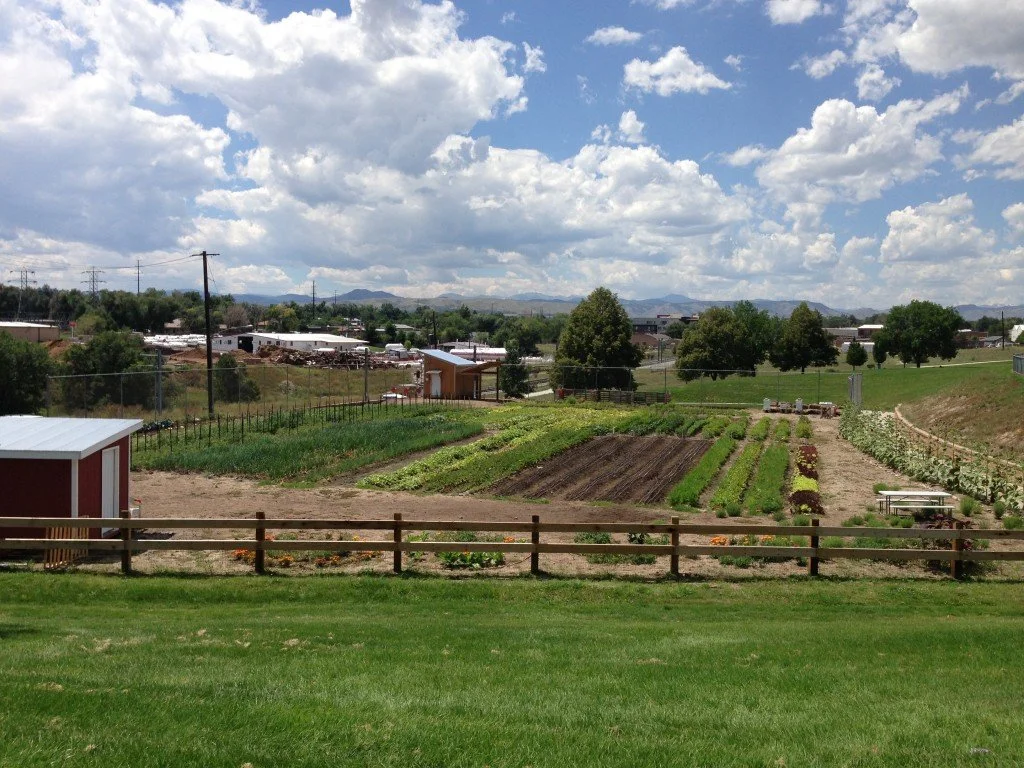
The farm was built in direct response to residents’ request for more access to fresh, healthy food and community gathering space in the neighborhood, through the 20-Minute Neighborhood Initiative conducted by the City throughout 2013. Residents were part of the planning and buildout, and a Community Advisory Committee composed of neighborhood stakeholders and partner organizations helps guide expansion of the Mountair Park Community Farm and its programs.
We average 10-12,000 pounds of food produced each year, and aim to distribute it equitably within the surrounding community. Beginning in 2026, the majority of the harvest is allocated to food access efforts, including:
on-site, donation-based farm stand in the parking lot of Mountair Park
donation-based farm stand for seniors at Creekside Senior Apartments
donations to local hunger relief efforts including food share programs at Angelica Village, Mountair Christian Church, The Action Center, Brown Bag Ministries, Kaizen Food Share, Andrea’s No Cost Market, and more.
Educational opportunities include programs for local schools, summer camp with the City of Lakewood, community events, volunteer days, tours, workshops, and vocational training through an internship and apprenticeship program.
Mountair Park Community Farm Beekeeper Program
Are you interested in keeping bees at Mountair Park Community Farm? Please review our Beekeeping Policy and submit your Mountair Park Community Beekeeper Application.
Dahlia Campus Farm, 2016-2018
(Now managed by WellPower)
SCF worked in partnership with the Mental Health Center of Denver (now called WellPower) from 2015-2018 to design, build, and operate the Dahlia Campus Community Farm at the Dahlia Campus for Health and Well-Being in Northeast Park Hill (NE Denver). WellPower now manages it on their own!

The Dahlia Campus incorporates a wide variety of community services and is a collaborative approach to growing and educating community members about food. The Dahlia Campus Farms and Gardens includes a one-acre urban farm, a 5,400 square foot aquaponics greenhouse, experiential gardens for children, horticultural therapy gardens, a food pantry/donation distributor and a farmers market. SCF enjoyed working with so many partners to bring this amazing project to life including MHCD/WellPower, Colorado Aquaponics, Children’s Farms of America, People’s Community Food Project, and Mo’ Betta Green Marketplace.
After partnering with Mental Health Center of Denver/WellPower for the first 4 years of the project—designing the space, building the farm, training the staff, and managing farm operations, food distribution, and education programs—in 2018, WellPower was ready to take it on and Sprout City Farms transitioned management of the Dahlia Campus Farm over to them. Both the on-site greenhouse (built with Colorado Aquaponics) and the 1-acre farm (built by us) are now under WellPower. They hired on our farm manager (who moved up the SCF ranks beginning with an internship and apprenticeship), and we’re proud to say we set them up for long-term success!
The Farm at Jack’s Solar Garden, 2021-2025
(no longer in vegetable production; full site now managed by Jack’s Solar Garden)
From 2021-2025, Sprout City Farms designed, built out, and managed 3 acres of land under solar panels for vegetable production, in partnership with Jack’s Solar Garden and research partners at University of Arizona and NREL.

Giant Science Experiment
This groundbreaking project paved the way for other agrivoltaic research farms operating now, like Chatfield and CSU!
During our 5 years of operation, Jack’s was the largest agrivoltaics site for vegetable crop production in the United States! Alongside research partners, Sprout City Farms trailblazed larger scale crop cultivation under solar panels, in an innovative farming practice called agrivoltaics (“agriculture” + “photovoltaics”).
Research/education partners included:
University of Arizona
National Renewable Energy Laboratory
Colorado State University
Colorado Agrivoltaics Learning Center
Over the years, we grew 62,000 pounds of farm-fresh produce! This was distributed through a CSA program, the Longmont Farmers Market, Boulder County Farmers’ Market’s WIC and SNAP programs, St. Vrain Valley Schools, and produce donations to Longmont Food Rescue, The OUR Center, and other local food relief partners.
With cancellation of USDA grant funds beginning in spring 2025, it was difficult to continue and we closed the vegetable farm at the end of the 2025 season.
We are proud to have helped seed the agrivoltaics movement in the US and plan to share our 5-year findings widely so that more farms can adopt these practices and harvest both crops and the sun as sources of revenue!